Are Your Best Customers Growing or Quietly Drifting Away?
How top companies turn existing customers into predictable, profitable growth.

The Quick Read
Many growing companies have added customers faster than they have built a process to keep and grow them. This research paper shows where customer value quietly leaks, including relationships that rest on a single stakeholder, and the six steps top-performing companies use to protect and grow the revenue already inside their customer base. An illustrative $200 million company shows how a three-point retention gain plus modest expansion could add $8.6 million in annual revenue and $3.6 million in operating profit. Use the self-assessment and leadership tool that accompany the paper to see where your team stands and what to inspect first.
Put it to Work
- Which customers bring in the revenue you cannot afford to lose this year?
- If one or two of your biggest customers left this year, how much would it cost you?
- Which key accounts rest on a single relationship?
- How often do your managers coach customer-facing skills instead of stepping in themselves?
- Where is your biggest customer growth gap? Take the 12-question Customer Growth Self-Assessment to find out.
Why are existing customers now the growth plan?
Short answer: Existing customers produce roughly 70% of a mid-sized company's revenue, and 73% of sales leaders now prioritize growing them (Gartner, 2025).
Yet the way many teams onboard, engage, retain, and expand customers was never formally established, or has not been revisited since the company was much smaller. Retention and expansion depend on the individual effort of a few dedicated people, and leadership often learns about risk when a renewal is already in question.
Gartner calls the central risk a customer value gap: the distance between the value a supplier promises and the value its customers actually realize. When customers cannot see the value they received, renewal conversations tend to become price conversations.
Top performers close that gap across four connected post-sale stages, each one building the value and trust that help the next stage succeed. A gap in any stage tends to show up later as churn, a stalled account, or a referral that never comes.
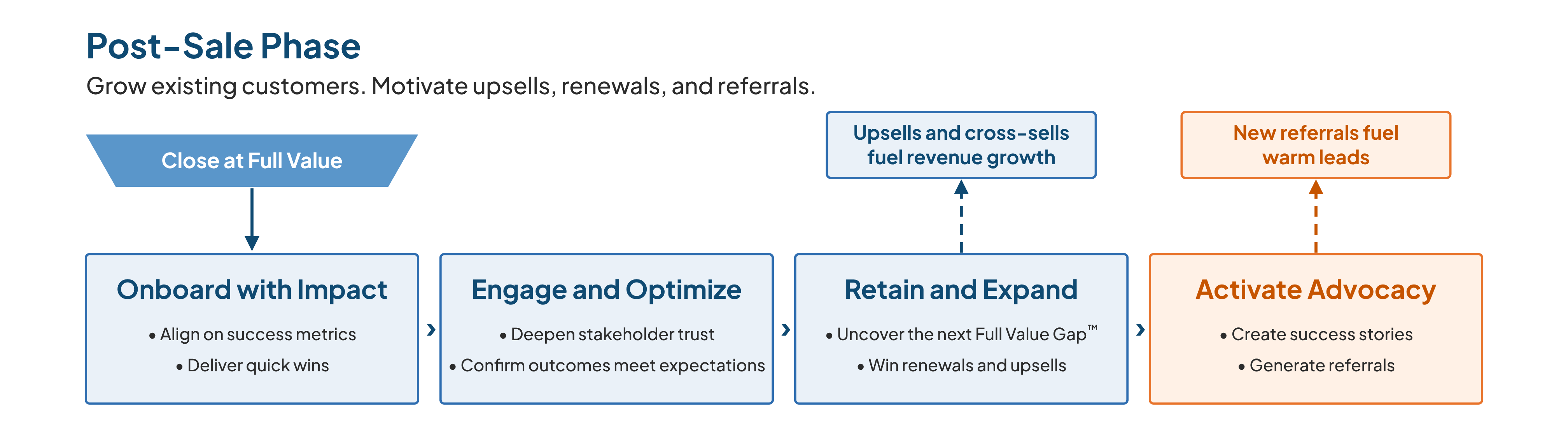
Where does your team stand today? Take the Self-Assessment →
Where does customer value quietly leak?
Short answer: In ordinary moments: transactional interactions, missed risk signals, expertise that never translates, and relationships that rest on a single contact.
Leaders often assume customers leave after a dramatic failure. The research points to friction-filled everyday moments. 96% of customers who have a high-effort service interaction become more disloyal (CEB, now Gartner). Value leaks when interactions stay transactional, when warning signs go unnoticed, and when experts explain their work in technical terms instead of the outcomes customers want.
The biggest leak is a relationship that rests on one contact. Bold Value Partners finds that complex B2B decisions typically involve four to thirteen stakeholders. When a new executive arrives or your contact moves on, the relationship can leave with them. Customer teams that understand every stakeholder's goals are positioned to uncover the next Full Value Gap™ before a competitor does.
Why weren't most customer teams trained to grow accounts?
Short answer: Customer-facing professionals are often hired as experts, advisors, and problem-solvers, and their training rarely covered how to recognize and lead a growth conversation.
Many take pride in not being salespeople, so a traditional sales program is likely to be rejected on contact. Specialized training for non-salespeople works when it frames the skills as elevating the customer experience: listening well, connecting with every stakeholder, communicating value in the customer's language, and recognizing when a customer's goals call for a growth conversation.
The effect shows up in loyalty and share of wallet. When service interactions enhance the value customers see, Gartner found the following:
Skills last when they are reinforced in the flow of work: short lessons built around real customer situations, practice with peers, application on live accounts, and manager coaching. Quality coaching can lift the performance of the middle 60% of a team by up to 19% (Harvard Business Review).
What six steps do top companies use to grow existing customers?
Short answer: They build a customer growth process connected to their sales methodology, then track, coach, and measure it like new business.
Top performers name the outcome, find where value leaks, build confidence in their people, equip managers to coach, make customer growth visible, and measure the value at stake. They forecast retention and expansion with the same confidence they expect from new sales.
Six Steps to Customer Growth
What are a few points of customer retention worth?
Short answer: For a $200 million company, a three-point retention gain plus modest expansion can add $8.6 million in revenue and $3.6 million in operating profit (illustrative).
The paper follows Northfield Industrial, a $200 million composite drawn from Bold Value Partners client work, which earns $140 million from existing customers. Raising retention from 90% to 93% adds $4.2 million in revenue. Adding $3 million of expansion and discounting one point less to keep key customers brings the total to $8.6 million in revenue and $3.6 million in operating profit.
See the research, the six steps, and a fillable readiness worksheet. Download the full paper →
How do leaders make customer growth predictable and repeatable?
Short answer: They give each key customer a stage in the CRM, define what the customer confirms to complete it, and review stage movement with each account owner every month.
When managers review key accounts by stage, they spend less time collecting updates and more time asking what each account needs to advance. Leadership gets a retention and expansion forecast built on where each customer actually stands, with large renewals visible months in advance.
Leaders don't need to run these steps themselves. They need to inspect them. The CEO's role is to ask the customer leader which accounts carry the revenue the company cannot afford to lose, when key customers last saw their results, how many stakeholders the team reaches in each account, and how managers are coaching the skills that move customers forward.
Bold Value Partners helps leadership teams build a customer growth process that protects and grows key accounts, using the Bold Value Method as the shared foundation across sales and customer-facing teams.
See How We Help You Solve This →Frequently Asked Questions
Who is this paper written for?
CEOs, presidents, and operations and customer experience leaders at small to mid-sized B2B companies who want more predictable, profitable growth from the customers they already serve.
What is a customer growth process?
The defined way a company onboards, engages, retains, and expands existing customers, connected to its sales methodology and tracked in the CRM.
Who should own customer retention and expansion?
Account owners own each relationship, the customer-facing leader owns the process and forecast, and the CEO or President inspects results quarterly.
How do non-salespeople help expand accounts?
By elevating the customer experience: confirming results, connecting with every stakeholder, and recognizing when a customer's goals call for a growth conversation.
How do you track customer growth stages in a CRM?
Add a stage field to each key account in HubSpot, Salesforce, or another CRM, then review stage movement with account owners monthly.
How does the Customer Growth Self-Assessment work?
You answer 12 questions across six areas in about five minutes. You then receive your score for each area and a free, personalized report with a 30-day blueprint for improving your lowest scores.

The Full Research Paper
The complete paper with the six steps top companies use, the research behind each one, what retention is worth, and a fillable readiness worksheet.
Customer Growth Scorecard
In 5 minutes see how well your team retains customers, expands accounts, and connects with every stakeholder, and receive your free personalized report with a 30-day blueprint.

Why Your Best Customers Drift
Walt explains how top companies keep their best customers growing and what leaders should inspect first.
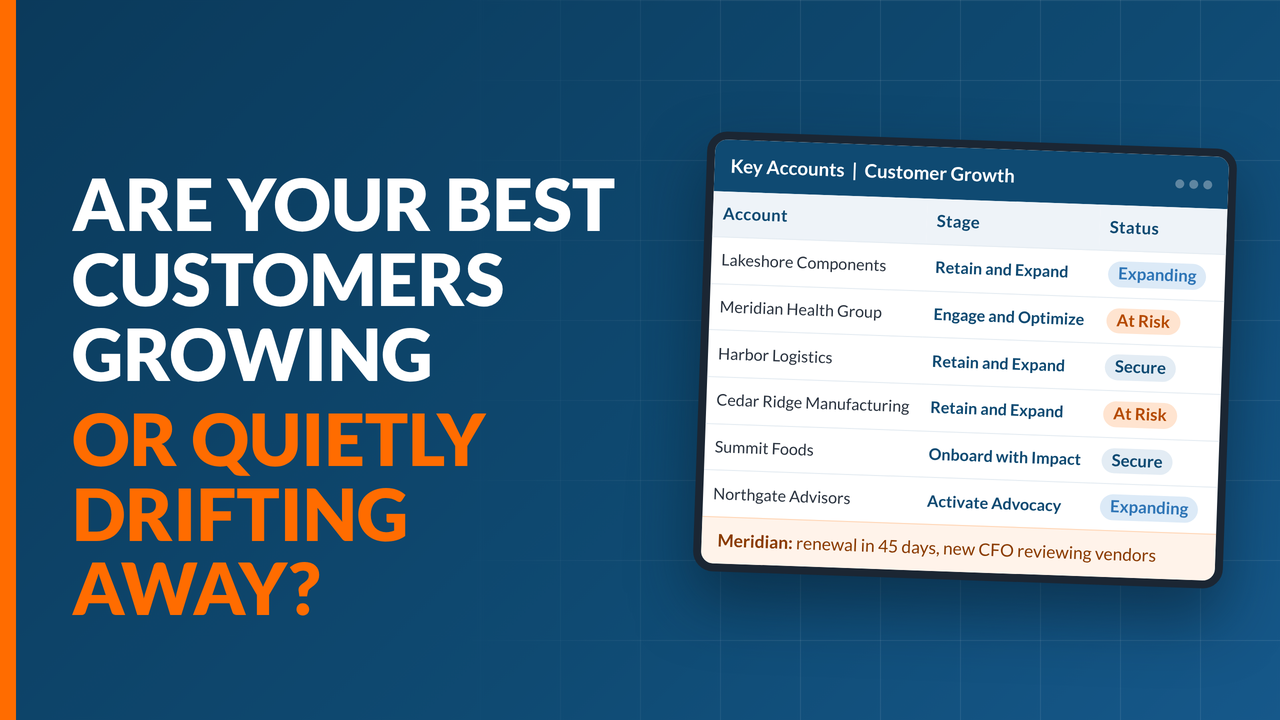
Customer Growth Portfolio
A fillable leadership tool to see which key accounts are secure, which are at risk, and where the next dollar of growth will come from, then coach your team forward.
Free Growth Insights Delivered to Your Inbox

© 2026 Bold Value Partners